Highlights from The State of the Global Climate 2025

The World Meteorological Organization, 2026, recently published its annual report on climate change. The State of the Global Climate 2025 was released on March 23, 2026. And can be found here: https://library.wmo.int/idurl/4/69807

WMO Secretary-General, Celeste Saulo, wrote, “Let us ensure that Earth information is not only collected — but also understood, accessible, and actionable for all.”

In keeping with the wishes of the WMO Secretary-General, this short blog post will list the important highlights of the report. Summaries are slightly paraphrased for ease of readability.

·      Increasing concentrations of greenhouse gases in the atmosphere reached their highest level in 800,000 years (p. 5).

·      The year 2024 was the warmest year on record since modern temperature records were kept. The years 2023 and 2025 are the second or third warmest years (p. 5).

·      The past eleven years, 2015-2025, were the eleven warmest years on record and the past three years, 2023–2025, were the three warmest (p. 9)

·      The vast majority of heat produced by GHG emissions – around 91% – is absorbed by the oceans (p. 5).

·      The atmospheric concentration of carbon dioxide (CO2) reached its highest level in the last 2 million years. Levels of methane (CH4) and nitrous oxide (N20) reached their highest levels in the last 800,000 years (p. 6).

·      Ocean heat content has set a new record over the past nine years, each year surpassing the record temperature of the previous year (p. 10).

·      So much heat has entered the oceans that it will require hundreds to thousands of years to reverse the trend (if emissions can be reduced). That means sea level rise is irreversible in human timescales (p. 11, 13).

·      An estimated 29 percent of the CO2 emitted by human activities during the decade 2015–2024 was absorbed by the ocean, leading to an increased acidification of the oceans (p. 14).

·      Eight of the ten most negative glacier mass losses since 1950 have occurred since 2016 (p. 5, 16)

·      Ice loss from glaciers contributed around 21 percent of the total sea-level rise. Ocean warming contributed 42 percent of the total rise, and melting of the ice sheets in Greenland and Antarctica contributed 15 percent and 8 percent  (p. 17).

·      Glacier retreat since the 1950s, with almost all of the world's glaciers retreating synchronously, is unprecedented in at least the last 2,000 years (p. 17).

World Meteorological Organization (WMO). State of the Global Climate 2025. (WMO-No. 1342). Geneva, 2026. Link: https://library.wmo.int/idurl/4/69807

The Good, the Bad, and the Ugly

December 2025 marked a decade since the Paris Climate Accord was signed, the first unanimous pledge by all the countries in the world to try to reduce greenhouse gas (GHG) emissions that are heating the planet to dangerous levels. In the 10 years since the national delegates met for this historic event, a lot has happened, some of it good, some of it bad, and some of it downright ugly.

The entire 25-page Paris Climate Accord document is available on the UNFCCC webpage. Link: https://unfccc.int/process-and-meetings/the-paris-agreement

In this blog post, I’ll describe the achievements and shortcomings that I believe should fall into these three categories. This is a living document and I’d welcome inputs from readers who would like to add contributions (or corrections) to the lists. As usual, I’ve included links or notes to the original references so readers can double-check the facts.

The Good:

Extreme temperature predictions are down. In 2014, temperature increases on the planet were predicted to reach 4.0 degrees Celsius by 2100, according to IPCC scientists. However, in the most recent IPCC assessment report in 2023, climate experts predicted a new high temperature of 3.2 degrees Celsius (above pre-industrial levels). In a more recent prediction, the United Nations Environmental Program (UNEP) reported in November 2025 that temperatures will peak at 2.8 degrees Celsius by 2100. These are still very dangerous temperature levels, but better than previous predictions.

Sources: The 2014 IPCC Assessment Report predicted, “In most scenarios without additional mitigation efforts, warming is more likely than not to exceed 4 degrees Celsius above pre-industrial levels by 2100.” See IPCC‘s Fifth Assessment Report (Synthesis Report), 2014, p. 18-19; IPCC Assessment Report Six (AR6) Working Group 3 (WG3), section C.1, 2022; IPCC Assessment Report Six, Synthesis Report, 2023, section A.4.4. See also the United Nations Environment Programme (2025). Emissions Gap Report 2025: Off target – Continued collective inaction puts global temperature goal at risk [Olhoff, A., chief editor; Lamb, W.; Kuramochi, T.; Rogelj, J.; den Elzen, M.; Christensen, J.; Fransen, T.; Pathak, M.; Tong, D. (eds)]. Nairobi, p. xiii.

Solar and wind are now the cheapest forms of power. Solar photovoltaic (PV) panels are now cheaper than ever. According to the International Renewable Energy Agency (IRENA), solar panels were 41 percent cheaper than the least expensive fossil fuel alternatives. The solar market is shining. According to energy think tank Ember, 647 GW of solar capacity was added globally in 2025, an 11 percent increase from the 582 GW installed in 2024. Total solar capacity weighed in at almost 2,900 GW by the end of 2025. Solar power capacity grew by more than 1,000 percent from 2014 to 2024 and is expected to reduce GHG emissions by three gigatons in 2030. Wind power is close behind. Wind increased 47%, jumping to 167 GW in 2025 from 2024's 113 GW. By the end of the year, wind capacity globally reached 1,300 GW. Wind power may not be as widespread as solar, but it is even cheaper: on average, 53 percent less expensive than fossil fuels (as compared to solar’s 41%). Wind power will reduce emissions by one gigaton, according to one report. In total, the world installed 814 GW of new solar and wind capacity in 2025, 17% more than in 2024 (696 GW), according to Ember. The combined capacity of wind and solar reached 4,174 GW (over 4 TW) in all.

Sources: IRENA, “91% of New Renewable Projects Now Cheaper Than Fossil Fuels Alternatives,” 22 July 2025. Link: https://www.irena.org/News/pressreleases/2025/Jul/91-Percent-of-New-Renewable-Projects-Now-Cheaper-Than-Fossil-Fuels-Alternatives. For wind power, see Benjamin Legendre, “Three positive climate developments,” Phys.org, 24 Nov 2023. See also, Michelle Lewis, “World adds a record-breaking 814 GW of solar and wind in 2025,” Ember, 20 Mar 2026.

China, the world's leader in renewable energy. China – aside from being responsible for one-third of current global emissions – is leading the charge on renewable energy systems. The Asian giant implemented 60 percent of the new renewable capacity brought online in 2023 and is installing more solar panels than the rest of the world combined. China also leads in electric vehicle (EV) manufacturing. EVs already account for 20 percent of global car sales, an amount expected to rise to 50 percent by 2030. The 13 million electric and hybrid vehicles sold by China in 2024 were four times the amount sold in the U.S. Premier Xi Jinping promised that China's emissions would peak before 2030 and reach carbon neutrality by 2060. However, China remains heavily dependent on coal. It burns more coal than the rest of the world combined to provide energy and electricity for the country's 1.4 billion inhabitants. In 2023, for example, the country brought an additional 114 gigawatts of coal plants online.

Notes and sources: China, with 31%, is the world's largest emitter, overtook the United States in 2006. As of 2024, the United States was second with 13%. In 2023, India passed the European Union as the third-largest emitter. See Zhu Liu, et al, “Global Carbon emissions in 2023,” Nature Reviews, 04 April 2024. See also International Energy Agency (IEA), World Energy Outlook 2024, October 2024. Link: https://www.iea.org/reports/world-energy-outlook-2024; Christian Shepherd, “How China pulled ahead to become the world leader in electric vehicles,” Washington Post, 03 March 2025; Michael Wayland, “EV, hybrid sales reached a record 20% of U.S. vehicle sales in 2024,” CNBC, 16 Jan 2025.

New low-emissions technology advancing every day. Progress in technology to reduce emissions and decarbonize the atmosphere is coming online: Carbon capture and storage, improvements in battery longevity, nuclear fusion, and photovoltaic systems offer a glimmer of hope. Emission-free green hydrogen can provide a cleaner maritime shipping fuel. Biofuels for aircraft could help that industry. Battery technology and storage have also made important advances; more than 75 gigawatts of storage capacity were added in 2024.

Sources: World Energy Outlook 2025 from International Energy Agency (IEA), p. 20; Visual Capitalist, https://www.visualcapitalist.com/charted-renewable-energy-capacity-in-the-u-s-2014-2024/, accessed 01 Aug 2025.

Global Methane Pledge. In November 2021, at the Glasgow, Scotland COP26, more than one hundred countries vowed to reduce methane emissions by the end of the decade, a promise that became known as the Global Methane Pledge. Methane is responsible for about one-third of the global warming that has occurred and is a much more powerful GHG than carbon dioxide, generating about 80 times the warming that CO2 does in the first 20 years after its release into the atmosphere. By November 2023, the number of participating countries had increased to 155. Sadly, China, India, and Russia refused to ratify the treaty.

Source: Drew Shindell, et al, “The methane imperative,” Frontiers in Science, 30 July 2024. For info on methane, see Szopa, S., et al., ‘Short-lived climate forcers’, in Intergovernmental Panel on Climate Change, Climate Change 2021: The Physical Science Basis. Contribution of Working Group I to the Sixth Assessment Report of the Intergovernmental Panel on Climate Change, ed. V. Masson-Delmotte et al. (Cambridge: Cambridge University Press, in press), https://www.ipcc.ch/report/ar6/wg1/.

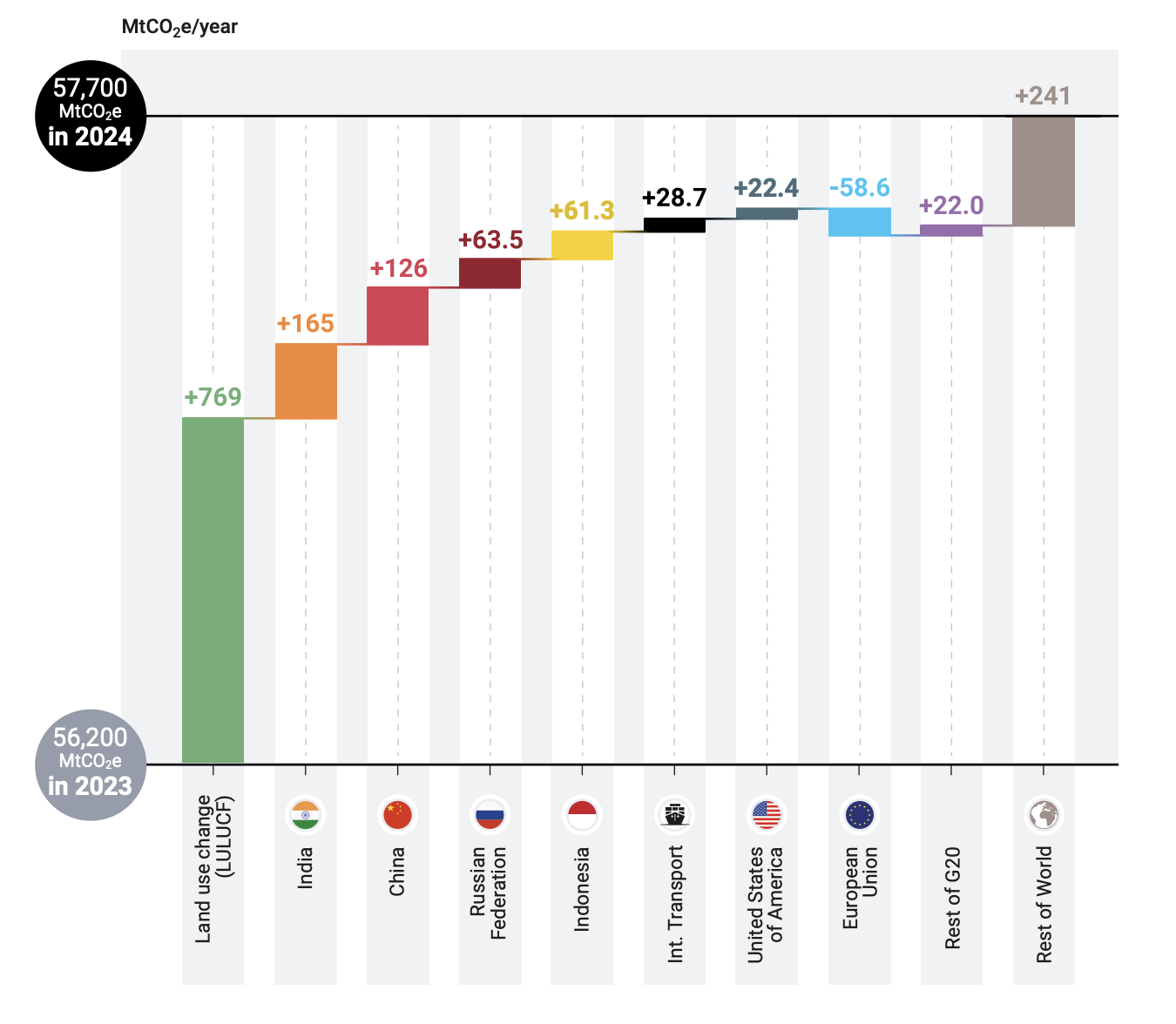
Deforestation has decreased. This is important news because land use (formally called  “land-use, land-use change, and forestry” or LULUCF) is the biggest contributor to GHG emissions, larger than most other sectors (industry, transportation, electricity generation, etc.) and responsible for more than half of all emissions. Brazilian President Lula da Silva, re-elected in 2023, pledged to stop deforestation in the Amazon (the largest rainforest in the world) by 2030. Deforestation in his country decreased by 36 percent from 2022-2023, a 5-year low after a half-decade of backsliding because of the weak environmental policies of his predecessor, Jair Bolsonaro. Colombia has even more impressive achievements; under the policies of President Gustavo Petro, deforestation decreased by 49 percent in 2023 compared to national statistics in 2022. Outside of South America, Indonesia and the Democratic Republic of the Congo are the highest LULUCF emitters.

Source: See Friedlingstein, P.: Global Carbon Budget 2025, Earth Syst. Sci. Data Discuss (draft version as of 02 Jan 2026); The Economist, “Brazil and Colombia are curbing destruction of Amazon rainforest,” 07 Apr 2024.

Figure 1. Global GHG emissions continue to rise in 2024 despite the warnings of scientists. Of the seven largest emitting countries, only the European Union has seen a decrease in emissions from 2023 to 2024. In the far left column, deforestation (called LULUCF) is the biggest contributor of GHG emissions, equal to the emissions of the top seven countries. Source: Emissions Gap Report 2025: Off target – Continued collective inaction puts global temperature goal at risk [Olhoff, A., chief editor; Lamb, W.; Kuramochi, T.; Rogelj, J.; den Elzen, M.; Christensen, J.; Fransen, T.; Pathak, M.; Tong, D. (eds)]. Nairobi, p. vi.

The World Court decision to hold governments accountable for their pollution. On July 23, 2025, the United Nations’ highest court ruled that nations have a responsibility to limit fossil fuel emissions and prevent environmental harm. The International Court of Justice (ICJ) called climate change an “existential threat of planetary proportions that imperils all forms of life.” Representatives from petrostates such as the United States, Saudi Arabia, and Russia testified to the Court that current GHG limiting efforts were adequate and advocated for maintaining the status quo. U.S. delegates also contended that the international law cited by the court’s judges could not be imposed on private companies by governments. However, the court pushed back on that contention, stating that countries have a legal obligation to regulate private companies within their jurisdictions.

Source: Somini Sengupta, “Does the World Court’s sweeping climate opinion matter? Five takeaways.” New York Times, 23 July 2025; Chico Harlan, “U.N. court rules countries have duty to limit greenhouse gases,” Washington Post, 23 July 2025; Bjorn Lomborg, “There’s good news for lawyers in a landmark climate ruling. But not for the climate.” Washington Post, 19 Aug 2025.

The Bad:

2024 was the hottest year in human history. The global temperature increases in 2024 marked the hottest year in human history, breaking the record set the previous year in 2023. The year 2025 was the third hottest, and the planet's ten warmest years since 1850 have all occurred in the past decade (since 2015). As of October 2024, average planetary temperatures have exceeded 1.5 degrees Celsius for 14 consecutive months, a threshold scientists at the Paris Climate Conference in December 2015 said could be a dangerous red line that might mark the start of severe and possibly irreversible climate consequences.

Sources: NOAA Headquarters, “Earth's temperature peaks in 2024, marking hottest year ever,” Phys.org, 13 Jan 2025; Chico Harlan, Scott Dance, and Ben Noll, “You just lived through the hottest year on record. Again.” Washington Post, 09 Jan 2025; Delger Erdenesanaa, "Earth's 10 hottest years have been the last 10," New York Times, 18 Mar 2025; Nicola Jones, “When will global warming actually hit the landmark 1.5 ºC limit?” Nature, 19 May 2023; Richard Betts et al, "Approaching 1.5 degrees Celsius: how will we know when we've reached the crucial warming mark?" Nature 624, 2023; Chico Harlan et al, "The planet is warming so fast, it could cross a key climate limit in 2024," Washington Post, 08 Dec 2023.  

CO2 levels are still increasing. Despite the dire warnings from the Paris COP and thousands of other scientists, GHG emission levels are still increasing. According to the Global Carbon Budget report 2025, emissions grew 1.1 percent around the globe as coal, oil, and natural gas use continue to grow. In the latest Assessment Report, IPCC scientists warned the public that emissions have to be reduced by 43 percent by 2030 and 60 percent by 2035 to avoid crossing 1.5 degrees Celsius. But emissions are rising, not falling. Of the major emitters, only the European Union has seen a decrease in emissions. And the United States emissions have nearly doubled (up to 2.4 percent under President Trump from 1.1 percent under Biden) as the Trump Administration brings coal plants back online and withdraws government support for renewable energy. The growth rate of GHG emissions has slowed, from an annual average of 2.1 percent increase from 2000 to 2009, to 1.3 percent from 2010 to 2019. That is good news. But the current pledges from the Nationally Determined Contributions will only result in a one percent reduction. We are still moving in a dangerous direction, and time is running out.

Sources: NOAA Headquarters, “Earth's temperature peaks in 2024, marking hottest year ever,” Phys.org, 13 Jan 2025; Friedlingstein, P.: Global Carbon Budget 2025, Earth Syst. Sci. Data Discuss (draft version as of 02 Jan 2026); Chico Harlan, Scott Dance, and Ben Noll, “You just lived through the hottest year on record. Again.” Washington Post, 09 Jan 2025; Delger Erdenesanaa, "Earth's 10 hottest years have been the last 10," New York Times, 18 Mar 2025. Copernicus Climate Change Service (C3S), European Commission, "2023 is the hottest year on record, with global temperatures close to the 1.5°C limit," 09 Jan 2024. Link: https://climate.copernicus.eu/copernicus-2023-hottest-year-record; Copernicus Climate Change Service (C3S), European Commission, “Global Climate Highlights 2023, 09 Jan 2024, Link: https://climate.copernicus.eu/global-climate-highlights-2023; Dan Stillman, "The World is already experiencing record heat – in January," Washington Post, 25 Jan 2024; Scott Dance, “A year of record global heat has pushed Earth closer to dangerous threshold,” Washington Post, 05 June 2024; Chico Harlan, et al, “The planet is warming so fast, it could cross a key climate limit in 2024,” Washington Post, 08 Dec 2023; Brad Plumer, “U.S. emissions jumped in 2025 as coal power rebounded,” New York Times, 13 Jan 2026.

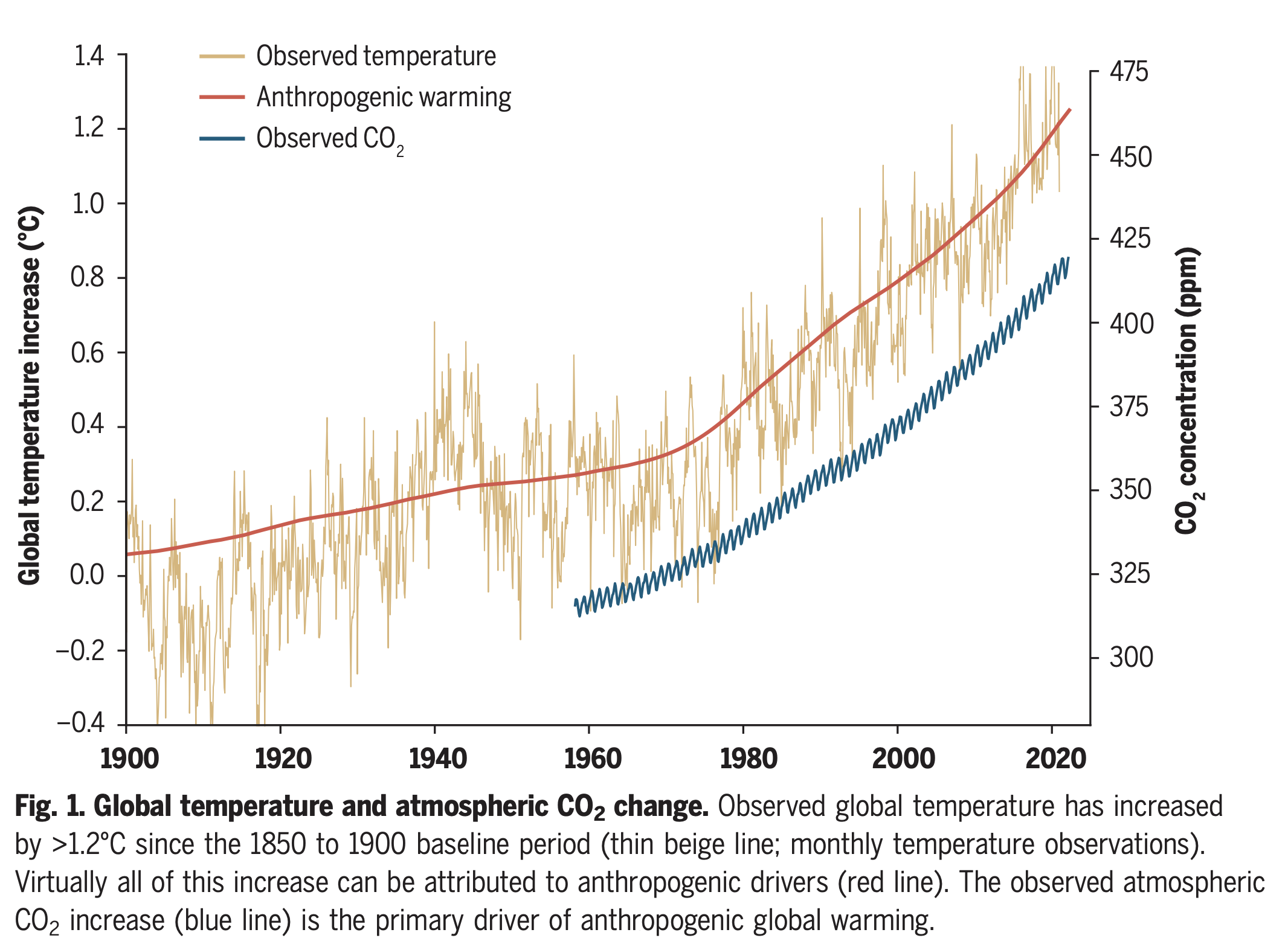
Figure 2. Global temperature and atmospheric C02 change. The correlation between increased levels of CO2 and average global temperatures should be obvious in this graph. See H. Damon Matthews and Seth Wynes, “Current global efforts are insufficient to limit warming to 1.5 degrees Celsius,” Science, 376, 2022, p. 1.

CO2 emissions hit an all-time high in 2025. Carbon dioxide emissions hit an all-time high in 2025, the highest levels of CO2 in the atmosphere in 14 million years. In December 2024, the CO2 concentration reached 424 ppm, according to NOAA.  Just six months later in June 2025, CO2 concentration levels broke 430 ppm, the second steepest increase since 1958, according to NOAA and the Scripps Institute. Scientists confirmed that the rise of CO2 levels is ten times faster than at any time in the past 50,000 years. More than 37 billion metric tons of CO2 entered the atmosphere in 2025. Ralph Keeling, director of the CO2 program at Scripps Institution in La Jolla, California, warned, "Not only is CO2 now at the highest level in millions of years, it is also rising faster than ever.”

Source: National Oceanic and Atmospheric Administration (NOAA), “During a year of extremes, carbon dioxide levels surged faster than ever,” 06 June 2024. Link: https://www.noaa.gov/news-release/during-year-of-extremes-carbon-dioxide-levels-surge-faster-than-ever; The Cenozoic CO2 Proxy Integration Project Consortium, “Toward a Cenozoic History of Atmospheric CO2,” December 2023. Link: https://www.science.org/doi/epdf/10.1126/science.adi5177 ; National Oceanic and Atmospheric Administration (NOAA), “During a year of extremes, carbon dioxide levels surged faster than ever,” 06 June 2024. Link: https://www.noaa.gov/news-release/during-year-of-extremes-carbon-dioxide-levels-surge-faster-than-ever; Sarah Kaplan, “Planet-warming pollution is growing at the fastest rate in history, scientists say,” Washington Post, 28 Oct 2024; Robert Monroe, “Annual Carbon Dioxide Peak Passes Another Milestone,” press release by UC San Diego and Scripps Institute of Oceanography, 05 June 2025.

The carbon budget is shrinking. Based on the amount of CO2 that humans produce annually, scientists can estimate how many more greenhouse gases can be discharged into the atmosphere and the temperature associated with that concentration of GHGs. For example, based on the amount of GHGs that enter the atmosphere, scientists can predict when the average global temperatures will reach 1.5 and 2.0 degrees Celsius, the dangerous thresholds that IPCC scientists warned can trigger dangerous climate consequences. This is referred to as the carbon budget, the net amount of greenhouse gas emissions (the amount produced minus the amount removed from the atmosphere). To stay below 1.5 degrees Celsius (average global temperatures above pre-industrial levels), about 90 percent of the carbon budget has already been used up, as of early 2025. That means, to stay below 1.5 degrees Celsius, humans can only release 170 more gigatons of CO2 equivalents. Since humans are producing about 40 gigatons of CO2 annually, that means the CO2 levels equivalent to 1.5 degrees Celsius will be reached in about four years or in the year 2029. To avoid crossing 2.0 degrees Celsius, 290 more gigatons of GHG remain in the carbon budget, about seven years of GHG emissions.

Sources: IPCC 2023 Synthesis Report, Annex I Glossary; Friedlingstein, P.: Global Carbon Budget 2025, Earth Syst. Sci. Data Discuss (draft version as of 02 Jan 2026); IPCC Assessment Report Six (AR6) Working Group 1 (WG1), Summary for Policy Makers, section A.2.2, 2021; IPCC AR6, ‘2021: Summary for Policymakers’, in: Climate Change 2021: The Physical Science Basis. Contribution of Working Group I to the Sixth Assessment Report of the Intergovernmental Panel on Climate Change. Cambridge University Press, Cambridge, United Kingdom and New York, NY, USA, pp. 3−32.

Fossil fuel companies continue to receive immense subsidies. Although some organizations have begun to divest from fossil fuel investments, the industry still receives immense support from governments. According to the International Monetary Fund (IMF), governments provided $7 trillion in fossil-fuel subsidies in 2022, more than many countries spend on education and about two-thirds of the total spent on healthcare. These massive government handouts are effectively a lifeline for oil and gas companies to continue “business as usual” instead of devoting funds to decarbonization efforts and phasing out their fossil fuel operations.

Source: Simon Black, Ian Parry, and Nate Vernon-Lin, “Fossil fuel subsidies surged to record $7 trillion,” International Monetary Fund (IMF), 24 Aug 2023; Jocelyn Timperly, “The fight to end fossil-fuel subsidies,” Nature, vol 598, 21 Oct 2021.  

Decarbonization efforts are moving too slowly. Because of the longevity of the GHG emissions that have already entered the atmosphere, we must not only stop producing additional emissions, but we must also remove the CO2 and other gases from the atmosphere, a process known as decarbonization. About 40 gigatons of CO2 enter the atmosphere annually. CO2 removal technologies such as carbon capture and storage (CCS) and direct air capture (DAC) are improving modestly, but the current carbon removal capacity is only a small fraction of the current fossil fuel CO2 emissions, according to the 2023 Global Carbon Budget report. In late 2024, the technology had improved to a level that companies were able to remove about two million tons of CO2 from the atmosphere each year. However, according to the International Energy Agency (IEA), the technology has to improve to the point that it can extract 600 million metric tons annually by 2050.

Sources: Friedlingstein, P., et al, “Global Carbon Budget 2023,” Earth System Science Data, 15, 5301–5369, 2023; Carl-Friedrich Schleussner et al., "Overconfidence in climate overshoot," Nature, vol 634, 10 Oct 2024, 366; Shannon Osaka, “Scientists have said that we can cool the planet back down. Now they’re not so sure.” Washington Post, 09 Oct 2024; Sara Budinis and Luca Lo Re, “Unlocking the potential of direct air capture: Is scaling up through carbon markets possible?” International Energy Agency (IEA), 11 May 2023; According to the University of Oxford’s report, The State of Carbon Dioxide Removal, about two billion tons of CO2 are removed from the atmosphere through reforestation.

Planetary ecosystems are failing. Until the start of the 18th-century Industrial Revolution, the planet's environment had been relatively stable for the past 11,700 years during the Holocene epoch. As Johan Rockström described it, the planet’s "regular temperatures, freshwater availability, and biogeochemical flows all stayed within a relatively narrow range." Scholars referred to these normal conditions as a “safe operating space for humanity.” In 2009, a team of 28 scientists led by Rockström developed an assessment of nine biophysical thresholds that are keeping the planet's climate and environment in a healthy condition. If those ecosystems fail, it could have disastrous environmental and human consequences. The authors warned in their initial report in 2009 that three of the thresholds – climate change, change in biosphere integrity, and biogeochemical flows – had already been breached. By 2023, three more had crossed a dangerous threshold: freshwater change, land system change, and Introduction of novel entities. The planet's stability and health are on the brink of failure, and it will have dangerous consequences for all species, including humans.

Source: Johan Rockström, “A safe operating space for humanity,” Nature, volume 461, 24 Sept 2009. A similar report was published in the Ecology & Society journal; Johan Rockström et al, "Planetary boundaries guide humanity's future on Earth," Nature Reviews: Earth and Environment, vol 5, Nov 2024.

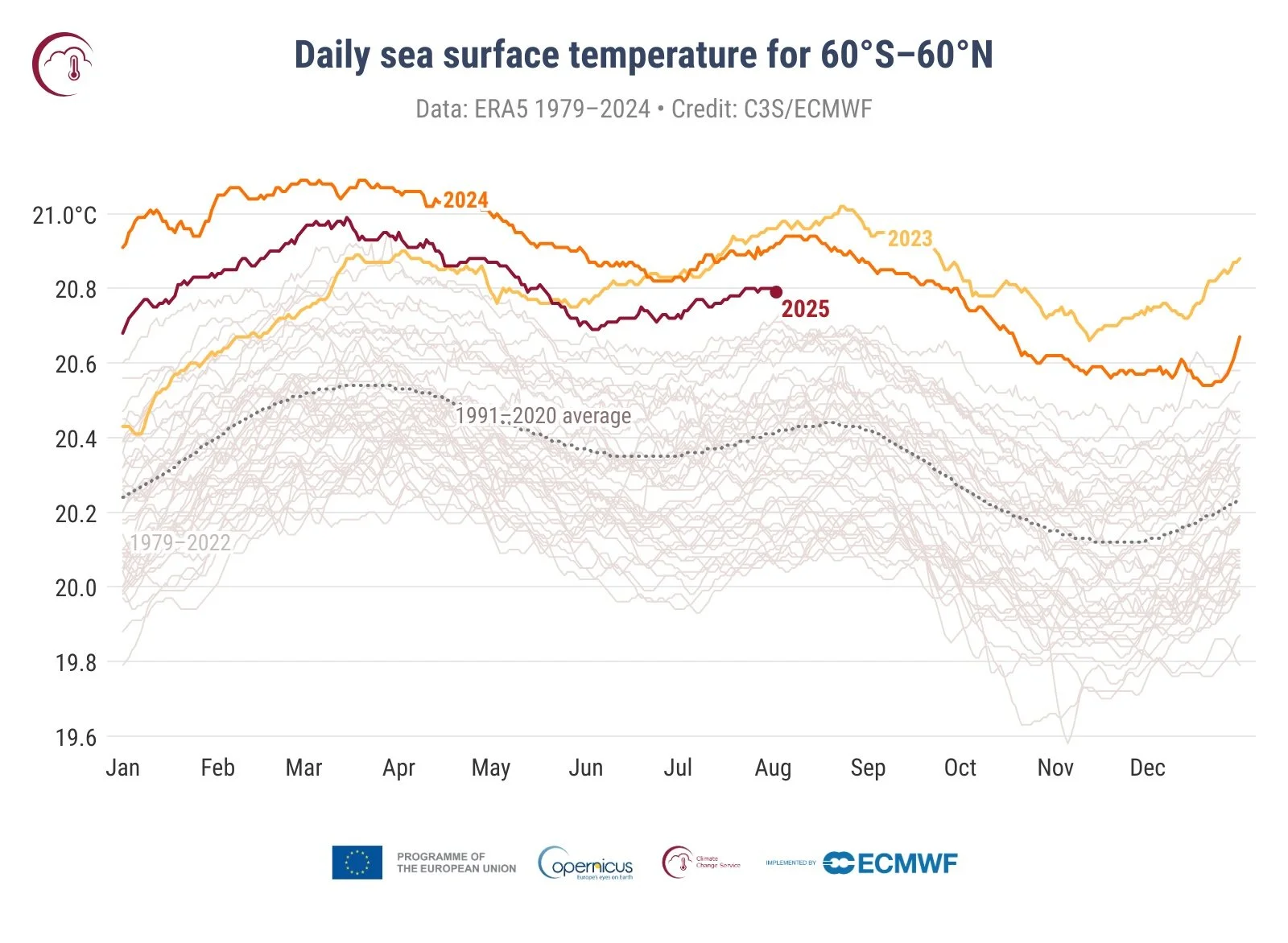
High ocean temperatures. Because the oceans absorb about 90 percent of the heat in the atmosphere, ocean temperatures have reached dangerously high levels. New ocean temperature records have been set every year since 2019, each year hotter than the previous. In 2024, water temperatures averaged 1.63 degrees Celsius above the pre-industrial average, the warmest ocean temperatures in thousands of years. Warm ocean waters serve as super-charged fuel for cyclones, increase sea level rise through thermal expansion, melt Antarctic ice shelves in contact with the ocean, and kill marine animals.

Sources: Lijing Cheng, et al, “Ocean heat content in 2023,” Nature Reviews: Earth and Environment, vol 5, April 2024; Peter Gleckler, et al., “Industrial-era global ocean heat uptake doubles in recent decades,” Nature Climate Change, vol 6, April 2016; Chinese Academy of Sciences, “Sea Surface Temperatures and Deeper Water Temperatures Reached a New Record High in 2024,” Advances in Atmospheric Sciences, 10 Jan 2025; Cheng, L., Abraham, J., Trenberth, K.E. et al. Record High Temperatures in the Ocean in 2024. Adv. Atmos. Sci. (2025). Lijing Cheng, et al, “Ocean heat content in 2023,” Nature Reviews: Earth and Environment, vol 5, April 2024; Peter Gleckler, et al., “Industrial-era global ocean heat uptake doubles in recent decades,” Nature Climate Change, vol 6, April 2016; EU’s Copernicus climatology center, “Streak of global records for surface air and ocean temperatures continues,” 06 June 2024. Link: https://climate.copernicus.eu/copernicus-may-2024-streak-global-records-surface-air-and-ocean-temperatures-continues.

Figure 3. Sea Surface Temperatures. Much of the heat in the atmosphere is absorbed by the world’s oceans. As a result, sea surface temperatures have increased dramatically. On average, 2025 had the warmest ocean temperatures in the history of humankind. These conditions will have immense effects on cyclone formation, thermal expansion, sea level rise, and the sustainability of the hydrosphere. Graph provided by EU’s Copernicus Copernicus Climate Change Service (C3S), link: https://climate.copernicus.eu/surface-air-temperature-july-2025. See also Global warming pushes ocean temperatures off the charts: study,” Phys.org, 14 Jan 2024; https://scx2.b-cdn.net/gfx/news/2025/sea-surface-temperatur-3.jpg, accessed 01 Sept 2025; Cheng, L., Abraham, J., Trenberth, K.E. et al. New Record Ocean Temperatures and Related Climate Indicators in 2023. Adv. Atmos. Sci. 41, 1068–1082 (2024).

The population is increasing rapidly. The planet’s population is surging toward 10.3 billion in 2080 from 8.2 billion in 2025. That marks an increase of 25 percent in the number of people on Earth. It took humanity 200,000 years to reach a global population of one billion inhabitants in the early 1800s. Just 200 years later, the population had skyrocketed to more than eight billion. The world population grows by 100,000 each day, or about 60 million new inhabitants each year. Each additional person adds stress on the carrying capacity of the planet, each requiring food, shelter, and living materials. The Earth has a finite amount of natural resources and, when combined with the problems of biodiversity loss, environmental degradation, and diminishing supplies of food and water, the planet's ability to sustain ten billion people may be exceeded. Food and water shortages are predicted to become extreme problems as global temperatures rise toward 3.2 degrees Celsius. Economic contraction, forced migration, heat waves, and civil unrest may cause a significant reduction in the global population in the second half of the 21st century.

Source: Eileen Crist, William Ripple, Paul Ehrlich, William Rees, and Christopher Wolf, “Scientists’ warning on population,” Science of the Total Environment, 05 July 2022.

Figure 4. World population growth. The global population has skyrocketed since the 19th century, jumping from about one billion in 1800 to 8.1 billion in 2024. UN officials estimate the global population will peak at 10.3 billion in 2080 and then begin to decrease. Source: Max Roser and Hannah Ritchie (2023), “How has world population growth changed over time?” Published online at OurWorldinData.org. Retrieved from: https://ourworldindata.org/population-growth-over-time, accessed 02 Sept 2025.

Failure to reach a plastics reduction agreement. Plastic pollution is an inherent part of the climate change crisis. Ninety percent of plastics are made in petrochemical plants, and plastic production is responsible for 3.3 percent of greenhouse gas emissions (2022 data), about the same as the commercial shipping industry. Global plastic production rose nearly 230-fold between 1950 and 2019, to more than 460 million tons a year. The current carbon footprint of plastics each year is equivalent to the emissions produced by 19-65 million cars annually. If no restraints or regulations are put in place, plastics production is expected to double by 2050 and triple by 2100, with an equivalent increase in emissions. Only 9% is recycled, according to the United Nations Environment Programme (UNEP). Single-use plastic – straws, containers, utensils, cups – make up 40 percent of the waste. An international effort to find a solution to plastic pollution, called the Global Plastics Treaty, was held in Busan, South Korea, in November 2024, but failed to reach a deal that would reduce plastic contamination.  Environmentalists considered the plastics treaty as important as the 2015 Paris Agreement on climate change. Treaty advocates vowed to try again. A follow-on conference was held on August 5-14, 2025, in Geneva, Switzerland. However, as in South Korea, the conference participants failed to reach an agreement, blocked mostly by large petro-states such as Saudi Arabia, Russia, and the United States.

Sources: Paul Stegmann, et al, “Plastics Futures and their CO2 Emissions,” Nature, Vol 612, 08 Dec 2022; Hiroko Tabuchi, The White House has a Plan to slash plastic use in the U.S.,” New York Times, 19 July 2024; Boyan Slat, “Reducing Plastic Pollution in Our Oceans Is Simpler Than You Think,” New York Times, 25 May 2023; Lisa Anne Hamilton and Steven Feit, “Plastic & Climate: The Hidden Costs of a Plastic Planet,” Center for International Environmental Law (CIEL), May 2019; Andrew Jeong, “Divided over whether to stop making plastic, U.N. treaty talks collapse,” Washington Post, 01 Dec 2024; See the homepage of the Intergovernmental Negotiating Committee on Plastic Pollution. Link: https://www.unep.org/inc-plastic-pollution/session-5#:~:text=The%20fifth%20session%20of%20the,Center%20in%20Busan%2C%20Republic%20of accessed 01 Aug 2025.

The Ugly

Temperature increases are accelerating. About 50 percent of all the GHG emissions have entered the atmosphere since the establishment of the IPCC in 1988, one-third of them since 2005. Scientists refer to the rapid changes since 1950 as “The Great Acceleration.” The 2024 global jump in heat – the highest temperatures in human history - greatly exceeded the climate models, bewildering scientists and worrying many observers. In October 2022, in its latest assessment report, the IPCC warned that the planet was on track to cross the dangerous red line of 1.5 degrees Celsius by 2030. However, record-breaking conditions in 2023 and 2024 – temperatures that shattered scientific predictions – have shocked scientists and may breach the 1.5-degree Celsius threshold as early as 2027. Other indicators, such as global sea level rise and ocean temperatures, are also increasing at rates higher than predicted. The rapidly worsening conditions have caught some scientists off guard, and a large consortium of climatologists has warned that "the climate crisis has arrived and is accelerating faster than most scientists expected." Bottom line: we may have less time than we anticipated to get the climate crisis under control.

Sources: More than 11,000 scientists from 153 countries contended that the planet is facing a climate emergency. William Ripple, “World Scientists’ Warning of a Climate Emergency,” BioScience, vol 70, no. 1, January 2020; William Ripple et al, "The 2023 state of the climate report: Entering Unchartered Territory," BioScience, vol 30, no 0, 2023; International Energy Agency (IEA), “CO2 Emissions in 2022,” March 2023; World Meteorological Organization (WMO), 17 May 2023. The term “Great Acceleration” was first introduced at the 2005 Dahlem Conference on the history of the human-environment relationship. Will Steffen, et al, “The Trajectory of the Anthropocene: The Great Acceleration,” The Anthropocene Review, 2015; Will Steffen, Paul Crutzen, and John McNeill, “The Anthropocene: Are humans now overwhelming the great forces of nature?” Ambio, vol 36, no 8, December 2007; Global Carbon Project, ‘Data supplement to the global carbon budget 2021’, 2021, https://doi.org/10.18160/gcp-2021;

The Biodiversity crisis. According to the World Wildlife Fund, animal populations around the planet decreased by 73 percent from 1970 to 2020. One-third of fish stocks are overexploited. The number of natural ecosystems has declined by almost 50 percent. An estimated one million animal and plant species (out of about eight million) are at risk of extinction. According to the IPCC, 70–90 percent of the coral reefs will sustain irreparable harm at 1.5 degrees Celsius of global warming. If temperatures reach 2.0 degrees Celsius, an estimated 99 percent will be destroyed, eliminating an essential marine ecosystem that will have compounding effects on other ocean life and on humans.

Sources: The WWF and Zoological Society of London (ZSL) manage the annual Living Planet Index as an annual assessment of the ecological health of the biosphere. Link: https://www.livingplanetindex.org/, accessed 20 Jun 2025. The group’s methodology has been scrutinized closely. See, for example, Catrin Einhorn, “Here’s what a shocking new number on wildlife declines really means,” New York Times, 09 Oct 2024; James Ashworth, “Extinction threatens nearly a quarter of all freshwater species,” Phys.org, 18 Jan 2025; Francois Keck, et al., “The global impact on biodiversity,” Nature, 26 March 2025; IPCC, 2023: Sections. In: Climate Change 2023: Synthesis Report. Contribution of Working Groups I, II, and III to the Sixth Assessment Report of the Intergovernmental Panel on Climate Change [Core Writing Team, H. Lee and J. Romero (eds.)]. IPCC, Geneva, Switzerland, section 3.1.2, p. 71.

Donald Trump's scorched-earth campaign. The Trump Administration has devastated the climate change mitigation efforts of the United States. Historically, the United States has been the largest GHG emitter over time, although it was surpassed by China in 2006. The country has pumped more dangerous contaminants into the atmosphere than any other country. Moreover, the U.S. has the largest economy in the world, and five of the 50 U.S. states have economies that rank among the top 20 countries in the world. Contrary to all scientific evidence and without any evidence to back up his unfounded rhetoric, Trump called climate change a hoax and, in front of the UN General Assembly, declared, "All of these predictions made by the United Nations and many others... were wrong. They were made by stupid people who have cost their countries fortunes and given those same countries no chance for success.” The list of the administration’s efforts to undermine climate change is long. The United States is the only country in the world to have left the Paris Climate Accord. The Administration cancelled the congressionally-mandated National Climate Assessment, fired most of its scientists, and shut down all the webpages with information on the program. Top U.S. scientists were forced to cease work with the IPCC. Administration officials terminated more than two dozen carbon capture projects worth $3.7 billion. During the presidential campaign, he publicly asked for $1 billion in campaign funds from petroleum companies. He relaxed mileage standards for cars and trucks and cancelled tax breaks for purchases of electric vehicles. His administration has tried to cancel the EPA's endangerment clause, which declared GHGs as harmful to public health. Polluting companies no longer have to report emissions data to the EPA. His hand-picked scientists have attacked the validity of climate change in a bogus report. And he has ordered shuttered coal plants to reopen. The Trump administration’s shameful abandonment of its obligation to correct decades of GHG emissions is a major setback at a critical juncture of the decisive decade, one that may seal the fate of humanity.

Sources: Alexandra Witze, "Trump gutted two landmark environmental reports — can researchers save them?" Nature, 02 May 2025; Zachary Wolf, “The US Government has declared war on the very idea of climate change,” CNN, 01 Aug 2025; Lisa Friedman, “Energy secretary attacks offshore wind and dismisses climate change,” New York Times, 05 Sept 2025; Willam Broad, “Historian see autocratic playbook in Trump’s attacks on science,” New York Times, 31 Aug 2025; Maxine Joselow, “EPA to stop collecting emissions data from polluters,” New York Times, 12 Sept 2025; Lisa Friedman, “Scientists denounce Trump Administraiton’s climate report,” New York Times, 02 Sept 2025.

 Tipping Points may have already being triggered. Some tipping points (often called "tipping elements" by scientists) may be triggered at temperatures between 1.5 and 2.0 degrees Celsius, the temperature recently reached in 2024. Because the 1.5 degrees Celsius threshold has already been crossed (in 2024), some feedback loops may already have commenced. These include the Greenland ice sheet, the West Antarctic ice field, coral reefs, and boreal permafrost. Others will be triggered at 3.0 degrees Celsius or higher. The IPCC's Sixth Assessment Report confirmed the same findings; the six tipping points at most risk of collapse were the West Antarctic Ice Sheet, the Greenland Ice Sheet, Arctic sea ice, permafrost, the Atlantic Meridional Overturning Circulation (AMOC), and the Amazon rainforest. Scientists warn that a runaway greenhouse gas effect could raise planetary temperatures to a "hothouse Earth" situation, which would make life unsustainable on the planet. In sum, the takeaway from this section is twofold: first, humanity may not have much time as it believes to take aggressive action to reduce GHG emissions, and second, the consequences of inaction may be much more consequential than many believe.

Sources: David Armstrong et al, "Exceeding 1.5 degrees Celsius global warming could trigger multiple climate tipping points," Science, 377, 09 Sept 2022; Will Steffen et al, "Trajectories of the Earth System in the Anthropocene," Proceedings of the National Academy of Sciences (PNAS), vol 115, no. 33, 14 August 2018; Timothy Lenton et al, "Climate tipping points – too risky to bet against," Nature, vol 575, 28 Nov 2019. Also reported by Johan Rockstrom, “Tipping Points and Feedback Loops,” p. 37, in Greta Thunberg’s The Climate Book. Timothy Lenton, et al, "Climate tipping points – too risky to bet against," Nature, vol 575, 28 Nov 2019.

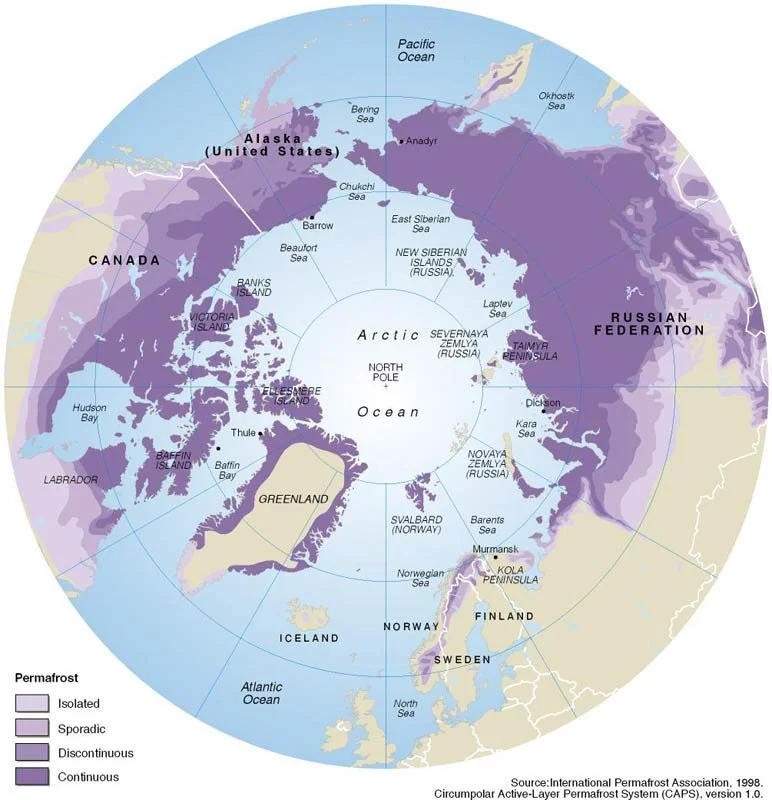
Figure 5. Permafrost in the northern hemisphere. An estimated 60 percent of Russia's landmass and 85 percent of Alaska's territory consist of permafrost. Darker shades of purple indicate larger percentages of permanently frozen ground. Lighter purples and the terms isolated and sporadic refer to lower percentages of frozen ground. The frozen soil composite contains an immense amount of carbon dioxide and methane. Graphic from International Permafrost Association (1998). See also Will Steffen et al, "Trajectories of the Earth System in the Anthropocene," Proceedings of the National Academy of Sciences (PNAS), vol 115, no. 33, 14 August 2018. 

Godzilla El Niño. The news in early 2026 that a strong El Niño may return in mid-2026 is very worrisome. Even before that news, World Meteorological Organization (WMO) scientists had predicted that the next five years would be even hotter than 2024, the hottest year in human history. The last El Niño in 2023 was partly responsible for a surge in global temperatures (the highest planetary temperatures in modern history), and the imminent 2026 El Niño may be unusually strong, earning it the moniker the Godzilla El Niño.

Sources: World Meteorological Organization (WMO), 17 May 2023. Source: https://public.wmo.int/en/media/press-release/global-temperatures-set-reach-new-records-next-five-years; Evan Quarnstrom, “‘Godzilla’ El Niño: A Climate Scientist Explains What Could Happen in Terms of Surf, Snow, and Coastal Erosion,” The Inertia, 16 March 2026.